

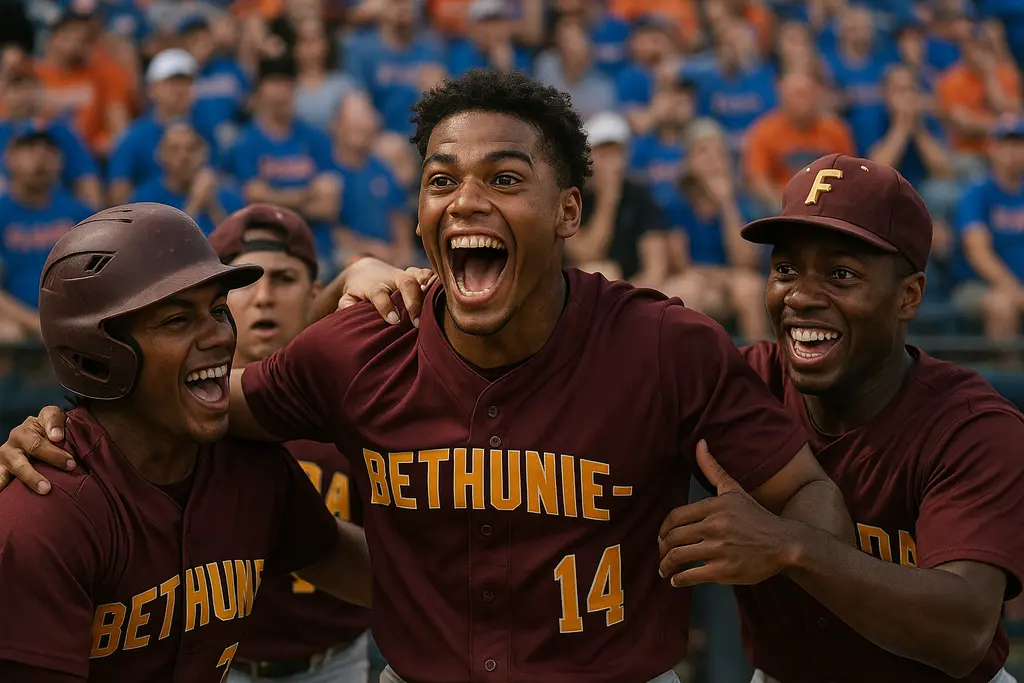
The Bethune-Cookman upset of Florida baseball on April 14, 2026, was not just a midweek surprise. It was a state baseball moment with a sharper edge: an HBCU program from outside the sport’s loudest power structure beat one of the most visible names in college baseball, and it did so by scoring enough to make the result impossible to dismiss.
Bethune-Cookman defeated Florida 13-7, with On3 reporting the Gators as No. 20 at the time of the matchup On3 game report. Sports Illustrated framed the same week through an even wider lens, noting Bethune-Cookman’s wins over two ranked SEC programs after a 10-7 victory against LSU on April 7 and the 13-7 win over Florida one week later Sports Illustrated report.
For Florida baseball fans, that matters because college baseball in the state is built around more than one brand. The Gators carry national expectations. Bethune-Cookman carries a different kind of identity, tied to HBCU athletics, conference pride, and the constant need to prove that roster depth and preparation can travel. On that April night, the smaller program did more than compete. It controlled the decisive inning and changed the conversation.
Why The Bethune-Cookman Upset Landed So Loudly
A Midweek Game With Real Consequences
The midweek slot can be misleading. It does not always carry the weekend shine of an SEC series, but it often exposes a team’s true depth. Coaches manage pitching staffs differently. Lineups may be adjusted. Younger arms are asked to cover innings. Defensive focus can be tested after a major weekend series.
That is why the Bethune-Cookman upset carried more weight than a normal nonconference result. Florida entered the game as a ranked team, and Bethune-Cookman arrived with a chance to build on a major win from the previous week. The setting asked both teams a simple question: which roster could keep its structure under pressure after the game stopped feeling routine?
The answer came late. Bethune-Cookman did not need a one-run escape or a strange weather-shortened result to create the shock. The Wildcats produced a decisive offensive inning, and that kind of separation matters in how fans remember a game. A late rally that creates a six-run final margin feels different from a narrow upset. It suggests poise, not just opportunity.
Local Pride Without Empty Hype
Florida’s college baseball audience is used to layered loyalties. Gators fans measure their program against SEC standards. HBCU supporters track representation and respect in spaces where resources are not always equal. Neutral local fans often respond to the team that gives them the best story. Bethune-Cookman supplied that story by beating a ranked opponent from the state’s highest-profile conference setting.
This is the kind of result that travels through dugouts, alumni circles, and youth baseball conversations. It gives young players a reference point: development can happen outside the most heavily covered programs, and a team does not need the biggest stage every weekend to produce a night that people remember.
Bethune-Cookman Upset And The Seventh-Inning Swing
How The Game Turned
The central baseball fact is direct: Bethune-Cookman broke a 5-5 tie with a seven-run seventh inning. On3 reported that the Wildcats took advantage of Florida pitching struggles and defensive errors in that frame, turning a tied game into a commanding lead.
That inning is the core of the Bethune-Cookman upset because it speaks to team dynamics. Upsets often require a favorite to open the door, but the underdog still has to walk through it. Bethune-Cookman did. A seven-run inning requires more than one swing. It requires baserunners, pressure, contact, patience, and the ability to avoid giving away at-bats while the opponent searches for outs.
From a coaching perspective, the seventh inning also exposed the stress points that midweek games can create. Once a pitching staff begins to chase matchups, every walk, misplay, and extended at-bat compounds the problem. For the Wildcats, that meant the chance to turn one Florida mistake into a sequence. For the Gators, it meant a tie game became a chase almost all at once.
- Date: April 14, 2026.
- Final score: Bethune-Cookman 13, Florida 7.
- Decisive moment: a seven-run seventh inning after a 5-5 tie.
- Context: Bethune-Cookman had beaten LSU 10-7 one week earlier.
Why One Inning Can Define A Program Week
Baseball is a sport of long seasons, but a single inning can define a week because it reveals whether a team can handle momentum. Bethune-Cookman had already shown it could finish against LSU. Against Florida, the Wildcats showed they could repeat that level of competitive nerve against another ranked SEC opponent.
That repetition is what separates an isolated upset from a program statement. Any team can catch a favorite on a bad night. Two ranked SEC wins in one week ask a different question. They force observers to consider whether the team’s preparation, approach, and belief were stronger than the label attached to the matchup.
What It Said About Florida’s Midweek Challenge
The Gators’ Loss Was Not A Schedule Footnote
For Florida, the result landed in an uncomfortable place. On3 reported that the loss to Bethune-Cookman was the Gators’ second midweek defeat of the season and came after a series win against No. 4 Georgia. That timing matters. A team can show high-end weekend ability and still reveal a softer side in midweek play.
That is not unusual in college baseball, especially for programs managing conference demands. Still, ranked teams are judged by how they reset. Florida’s next assignment, according to On3, was a three-game series against Auburn. That gave the Gators no long runway to sit with the loss. The sport moved quickly, as it usually does in April.
For Florida fans, the concern was not simply that the Gators lost. It was how the game turned. A 5-5 tie moving into the late innings is a manageable spot for a team with postseason expectations. Giving up seven in the seventh changes the read. It points attention toward pitching depth, defensive steadiness, and whether the team can avoid letting one stressful inning stretch beyond repair.
How Ranked Teams Absorb A Result Like This
Good teams do not treat every loss the same. A close loss to a strong opponent may point to small adjustments. A midweek loss with a large late inning demands a more direct review. Coaches study pitch execution, bullpen sequencing, infield communication, catcher-pitcher rhythm, and whether the team’s energy changed once pressure arrived.
That does not erase Florida’s broader ability. It does place the Bethune-Cookman game into a category that staff members and players cannot write off as noise. Ranked teams are expected to own the routine parts of the schedule. Bethune-Cookman made that routine label look false.
Why This Win Resonated Beyond One Box Score
Two Ranked SEC Wins Changed The Frame
The Bethune-Cookman upset over Florida gained force because it followed the 10-7 win against LSU on April 7. Sports Illustrated described the stretch as Bethune-Cookman beating two ranked SEC programs in one week, a phrase that explains why the Florida result moved beyond the usual underdog headline.
For HBCU baseball, moments like this create visibility that regular conference wins often do not receive. That visibility can affect how fans talk about the program, how alumni engage with the team, and how young players view opportunity. It also gives the SWAC a stronger talking point in the broader college baseball conversation, even if one week does not define an entire season.
There is a fan engagement piece here too. Local supporters often rally around proof. A ranked win gives a program proof for a day. Back-to-back ranked SEC wins give it proof that can last through a season’s storytelling. Bethune-Cookman earned that space by stacking results instead of relying on one night of attention.
The Underdog Label Was Not The Whole Story
Calling Bethune-Cookman an underdog is accurate, but it can flatten the baseball. The Wildcats still had to execute. They had to travel into a difficult matchup, answer Florida’s scoring, and stay composed long enough for the seventh inning to become theirs. The best upset stories are not built only on the favorite’s failure. They are built on the winning team’s ability to keep applying pressure.
That is what makes this result useful for coaches and players across Florida. It shows that midweek games reward complete attention. It also shows that reputations do not field ground balls, throw strikes, or produce quality at-bats. Teams do.
Why The Bethune-Cookman Upset Still Carries Local Weight
The Bethune-Cookman upset remains meaningful because it connects local identity with competitive reality. Florida baseball culture is not shaped only by SEC weekends or national rankings. It is shaped by nights when a program with less national attention forces everyone else to pay attention.
For Bethune-Cookman, the win over Florida gave the season a defining public marker. For Florida, it offered a reminder that midweek games are not empty space between conference series. For fans, it created one of those rare baseball memories that can be retold without needing much setup: Bethune-Cookman went to Florida, reached the seventh inning tied, scored seven, and won 13-7.
That is why the game belongs in the history category. Not because it decided a championship by itself, and not because it settles every debate about program strength. It belongs there because it captured the tension that makes college baseball compelling in this region: resource gaps, state pride, conference power, HBCU representation, and the daily truth that a clean inning can change how a team is seen.
The lasting lesson is simple. In Florida baseball, reputation brings attention, but execution earns the night. On April 14, 2026, Bethune-Cookman earned it.