


Florida State’s 2026 offense does not need to search for a defining playmaker. The Seminoles already have one. Duce Robinson enters the season as the receiver opponents must plan around, and his ability to transform defensive attention into opportunities for the rest of the offense could determine whether Mike Norvell’s team becomes a legitimate ACC contender.
Robinson enters 2026 after one of the best receiving seasons in recent Florida State history. The 6-foot-6 senior recorded 56 receptions for 1,081 yards and six touchdowns in 2025, becoming Florida State’s first 1,000-yard receiver since 2019. He also became one of the most dangerous explosive-play threats in the ACC, leading the conference in receptions of 20, 30, and 40-plus yards through the Florida State preseason All-ACC announcement.
That production explains why Robinson entered preseason discussions as one of the most important offensive players in college football. The conversation around Florida State has shifted from whether Robinson can become a star to how much the Seminoles can build around him.
For a program trying to climb back into ACC contention, that difference matters. Elite offenses usually have a player who changes defensive behavior before the ball is snapped. Robinson has reached that point.
Why Robinson Gives Florida State A Different Offensive Identity
Florida State’s offensive challenge in 2026 is creating consistency. The Seminoles have spent recent seasons trying to rebuild their identity after losing offensive stability, and the next step requires more than individual talent. It requires a player who can make the entire structure easier.
Robinson can do that because his skill set creates problems in multiple areas. His size creates matchup issues against smaller corners. His speed forces safeties to respect vertical routes. His contested-catch ability gives quarterbacks confidence when coverage is tight.
That combination changes defensive decision-making.
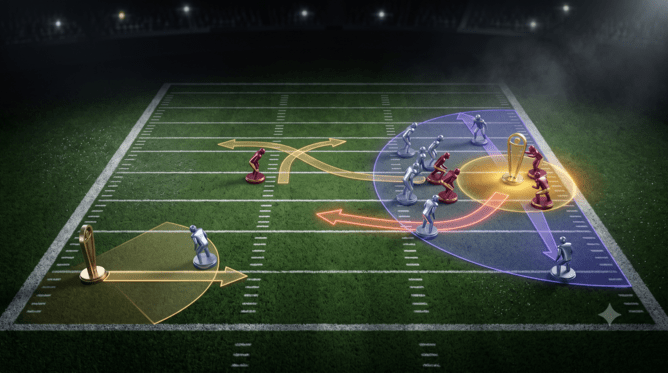
A defense that gives Robinson single coverage risks explosive plays. A defense that sends safety help creates space elsewhere. A defense that plays aggressively underneath can leave room for double moves and deep sideline routes. Florida State’s offensive staff can use that attention to create better opportunities across the formation.
This is the same type of roster-building logic FloridaFootballLive.com has followed when analyzing quarterback and offensive development stories. In the previous Florida State offense analysis, Robinson’s preseason recognition was examined as a sign of offensive potential. The next step is understanding why his presence can change the entire attack.
How Robinson Can Elevate Ashton Daniels’ Quarterback Play

The relationship between Robinson and Ashton Daniels may become the most important connection on Florida State’s offense.
Daniels enters 2026 with pressure to provide stability at quarterback, and having a receiver like Robinson gives him something every quarterback wants: a reliable answer when the defense creates uncertainty.
Robinson’s size allows Daniels to make throws that do not require perfect separation. A back-shoulder throw, a red-zone fade, or a contested sideline attempt becomes more realistic when the receiver has the physical profile to win those situations.
Florida State brought Daniels and Robinson to ACC Kickoff alongside head coach Mike Norvell and defensive back Ja’Bril Rawls, showing how central the duo is to the program’s 2026 story. Robinson arrived at the event after earning first-team All-ACC honors and third-team All-America recognition in 2025.
The quarterback-receiver connection still requires timing. Robinson’s production does not automatically solve protection issues, route timing, or decision-making. Daniels must consistently identify coverage, deliver accurate passes, and avoid forcing throws when defenses adjust.
The advantage is that Robinson gives him room for error. A quarterback developing confidence can grow faster when he has a receiver capable of turning difficult plays into completions.
Why Explosive Plays Could Change Florida State’s Ceiling
The biggest reason Robinson can raise Florida State’s ceiling is his ability to create explosive plays.
College football games often turn on a small number of moments. A 40-yard completion can erase an entire defensive series. A deep touchdown can change momentum. A contested catch on third down can keep a championship-level drive alive.
Robinson already proved he can create those moments. His 2025 season included five games with at least 120 receiving yards, and Florida State highlighted his conference-leading production in explosive receptions.
That ability becomes even more valuable in the ACC because defensive coordinators are increasingly focused on limiting explosive offense. Teams can survive by allowing short completions. They struggle when one mistake becomes a 50-yard gain.
Robinson forces defenses to make difficult choices.
| Defensive Choice | Potential Florida State Response |
|---|---|
| Double Robinson with safety help | More opportunities for other receivers and tight ends |
| Play press coverage | Robinson can use size and physicality at the line |
| Keep safeties deep | Florida State can create better running lanes |
| Bracket Robinson in passing situations | Daniels can attack underneath matchups |
The best version of Florida State’s offense does not require Robinson to catch 15 passes every week. His value comes from forcing defenses to adjust.
Why Robinson’s Blocking And Complete Skill Set Matter
The easiest way to evaluate a receiver is through catches and yards. The best offenses evaluate receivers through everything they do.
Robinson’s impact in 2026 will depend on whether he continues developing as a complete offensive player. Blocking, route precision, alignment versatility, and understanding defensive leverage all determine whether a receiver can stay on the field in every situation.
Florida State cannot become predictable by only using Robinson as a deep threat. If defenses know he is entering the game only for vertical routes, they can adjust. The Seminoles need him involved in the full offense.
That means moving him around the formation, creating mismatches against linebackers or safeties, using him on intermediate routes, and allowing him to influence the defense before the ball reaches him.
His size makes him valuable near the goal line. His speed makes him valuable outside the numbers. His experience makes him valuable in critical situations.
That combination is why Robinson is more than a receiver. He is an offensive structure piece.
The Supporting Cast Will Decide How Dangerous Robinson Becomes

Robinson’s talent is obvious, but Florida State’s offensive ceiling depends on whether the rest of the unit forces defenses to respect more than one threat.
If the Seminoles develop a reliable running game, Robinson becomes harder to bracket. If another receiver emerges, defensive coordinators lose the ability to focus coverage entirely on him. If the offensive line improves, Daniels has more time to allow deeper concepts to develop.
Florida State’s 2026 roster includes several offensive questions beyond Robinson, and preseason attention has centered on whether the Seminoles can turn individual talent into a complete attack. Recent analysis has pointed to Daniels and Robinson as major reasons Florida State is viewed as a potential breakthrough team entering the season.
The offense does not need Robinson to carry every possession. It needs him to make everyone else more effective.
That is the mark of a true difference-maker.
Why Robinson Could Become Florida State’s Offensive Foundation
Florida State has had elite offensive players before, but the best ones usually do more than produce statistics. They change how opponents prepare.
Robinson has reached that point.
A defensive coordinator cannot approach Florida State’s offense without accounting for where No. 0 lines up. That creates opportunities before Daniels throws a pass. It creates space before a running back receives a handoff. It changes how much freedom a defense has.
The next step is turning that respect into wins.
Florida State opens the 2026 season on August 29 against New Mexico State, beginning a year where expectations are much higher than they were after previous struggles. Robinson’s role will be measured by production, but his bigger impact will be whether the Seminoles become harder to defend throughout the season.
A 1,000-yard receiver can have a great individual season without changing a program. A true offensive centerpiece changes the entire environment around him.
That is the opportunity in front of Duce Robinson.
If he continues winning matchups, creating explosive plays, and making life easier for Ashton Daniels, Florida State may have the offensive weapon capable of pushing the Seminoles from a rebuilding project into an ACC contender.