


Duce Robinson’s preseason All-ACC selection gives Florida State something every reset offense needs before the first snap: a proven matchup answer. The Seminoles are not entering 2026 with vague optimism at wide receiver. They are entering with a 6-foot-6, 230-pound senior who already produced a 1,000-yard season, led the ACC in explosive receptions, and drew conference player-of-the-year attention before fall camp.
Florida State announced on July 29 that Robinson was named to the 2026 All-ACC Preseason Football Team after catching 56 passes for 1,081 yards and six touchdowns in 2025. The school also noted that he led the ACC during the regular season with 17 receptions of at least 20 yards, 12 catches of at least 30 yards, and six grabs of at least 40 yards through the Robinson preseason All-ACC announcement.
That changes the starting point for Mike Norvell’s offense. Florida State does not need to guess whether it has a perimeter player defenses must respect. The question is whether Robinson’s presence can raise the ceiling for Ashton Daniels, stabilize a rebuilt passing game, and give the Seminoles enough explosive-play threat to move from improvement story to ACC problem.
Why Robinson’s Selection Carries More Than Preseason Weight

Preseason teams can be dismissed as August noise, but Robinson’s selection has a stronger foundation than reputation alone. He became Florida State’s first 1,000-yard receiver since 2019 and produced the 14th 1,000-yard receiving season in program history. The ACC’s official preseason release listed Robinson among the league’s top offensive names, while Miami quarterback Darian Mensah was chosen as preseason player of the year with 97 votes. Robinson received 12 votes for that award, the most among wide receivers, according to FSU-focused coverage of the conference vote.
For Florida State, that matters because the offense needs a reliable identity marker. A year ago, Robinson was proof that the Seminoles could still create stress downfield even during a difficult team transition. In 2026, he becomes the piece opponents have to circle first.
That distinction matters for quarterback play. A new or pressured quarterback benefits from knowing where the coverage must tilt. If a defense shades safety help toward Robinson, the middle of the field can open. If it leaves him isolated outside, Florida State has a vertical and contested-catch target who has already shown he can punish single coverage.
That is why this topic connects with the broader quarterback-reset thread FloridaFootballLive.com has already covered in Alonza Barnett III’s UCF quarterback reset. UCF is trying to build a new offensive operating system around a proven transfer quarterback. Florida State has a different version of the same challenge: using a proven skill player to make the quarterback room look cleaner, faster, and more dangerous.
Why Robinson Changes The Geometry For Ashton Daniels
Ashton Daniels’ role in Florida State’s offense becomes easier to understand when Robinson is viewed as a coverage-shaping weapon. Daniels does not need to turn every dropback into a perfect full-field progression if the offense can define matchups before the snap. Robinson can help create those definitions.
Florida State’s official roster lists Robinson as a senior wide receiver from Phoenix, Arizona, after his previous stop at Southern California, while Daniels is part of the 2026 quarterback picture Norvell took into ACC Kickoff. The Seminoles’ official roster gives Robinson’s size at 6-foot-6 and 230 pounds, the kind of frame that creates different throwing windows than a smaller speed receiver.
That frame matters on third down and in the red zone. A quarterback does not need perfect separation when a receiver can shield defenders and win above the rim. Robinson’s contested-catch profile gives Daniels a margin for error that can keep drives alive. In the red zone, where space tightens and passing windows shrink, that body type can turn a covered route into a viable target.
The danger is overdependence. If Florida State treats Robinson as the only solution, defenses will compress the plan and force Daniels to win elsewhere. The better version of the offense uses Robinson to attract coverage, then attacks the grass he creates for tight ends, backs, and secondary receivers. Robinson’s value is highest when he is both a target and a decoy.
The Explosive-Play Data Changes Florida State’s Offensive Ceiling
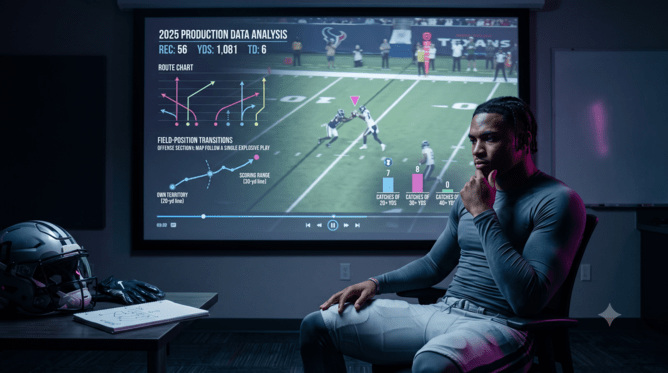
Robinson’s 2025 numbers were not built only on volume. The explosive-play data is the reason his preseason buzz feels tied to Florida State’s ceiling. FSU said he led the ACC in catches of 20, 30, and 40-plus yards during the regular season. That is not normal production. It means Robinson was not just moving chains; he was flipping field position.
Explosive plays are especially valuable for a team trying to climb back into conference relevance. Long drives require protection consistency, penalty discipline, run-game rhythm, and quarterback patience. Explosive gains can cover up some of those issues. They do not make flaws disappear, but they reduce the number of perfect snaps needed to score.
That matters for a Seminoles offense with questions elsewhere. Recent national and FSU-focused discussions have framed Florida State as a possible 2026 breakthrough team while still pointing to offensive line concerns and the need for Daniels and Robinson to drive the offense.
A receiver who can generate chunk plays gives the line a different kind of help. Defenses cannot sit downhill without respecting the vertical ball. Safeties have to stay honest. Corners have to protect against size and speed. Linebackers get less freedom to crowd run fits if the offense can punish single-high or aggressive looks.
Why Norvell Needs Robinson To Be A Weekly Structure, Not A Weekly Highlight
Norvell’s best use of Robinson should not be limited to deep shots. The receiver’s 2025 production shows he can hit explosive plays, but the 2026 offense needs him to become a weekly structure. That means planned touches, third-down targets, red-zone packages, motion usage, and route concepts that force defenses to declare coverage.
The Seminoles can move Robinson around without turning him into a gadget player. Boundary isolation can create one-on-one chances. Slot alignment can give him access to safeties and smaller nickel defenders. Condensed splits can help him release into crossing routes. Motion can reveal man or zone clues for Daniels. Those are practical ways to make one receiver affect the full call sheet.
Robinson’s academic profile adds another useful note. FSU’s release said he became Florida State’s first first-team Academic All-American since 2012 and the ninth in program history. That does not make him a better route runner by itself, but it supports the idea that the staff can trust him with a demanding role.
The best offenses build around players who can handle more than one assignment. Robinson’s size and production make him the obvious target. His experience and profile make him the player Florida State can use to organize the passing game.
What The ACC Preseason Vote Says About Respect And Pressure
Robinson’s 12 preseason player-of-the-year votes are a useful signal. They do not make him a favorite over quarterbacks such as Mensah, but they show that media voters see him as more than a strong receiver on a rebuilding offense. He enters 2026 as one of the league’s most visible offensive players.
That respect brings pressure. Florida State opponents will not treat him as a surprise. Defensive coordinators will spend offseason and game-week time building answers for his releases, contested catches, and vertical usage. Corners will try to crowd him early. Safeties will rotate late. Defensive fronts may attempt to speed Daniels up before Robinson’s routes fully develop.
That is why the next layer of his development matters. Robinson has to beat attention, not just coverage. He has to win when the defense knows where the ball wants to go. He has to produce when bracket looks take away clean first reads. The difference between a star receiver and an offense-raising receiver is how much production survives the game plan built to erase him.
| Robinson Factor | 2025/2026 Context | Offensive Impact |
|---|---|---|
| Size | 6-foot-6, 230 pounds | Creates red-zone and contested-catch advantages |
| 2025 Production | 56 catches, 1,081 yards, six touchdowns | Gives FSU proven top-target reliability |
| Explosive Plays | ACC leader in 20-, 30-, and 40-yard catches | Raises the offense’s field-position ceiling |
| Preseason Recognition | All-ACC selection, 12 player-of-the-year votes | Confirms league-wide respect and defensive attention |
| Quarterback Fit | Works with Ashton Daniels in Norvell’s 2026 offense | Can simplify reads and create coverage leverage |
Why Robinson Can Help The Run Game Without Touching The Ball
The receiving headline is obvious, but Robinson’s biggest effect may come on plays where he does not get a target. A defense that fears vertical throws and high-point catches has to allocate space differently. That can help Florida State’s run game.
If safeties stay deeper, the box lightens. If corners play with outside leverage to protect deep shots, quick inside routes and run-pass options gain space. If defenses use bracket help on Robinson, Florida State can identify favorable numbers elsewhere. A receiver who changes defensive spacing can make the run game more efficient without recording a catch.
That matters for a Seminoles team that cannot place the entire offense on Daniels’ arm. A more balanced attack would reduce obvious passing downs and keep Robinson from being double-teamed on every meaningful snap. The run game needs to create enough respect to keep defenses honest; Robinson can help by preventing safeties from living near the line of scrimmage.
The key is sequencing. Florida State has to show enough early vertical threat to pull coverage back, then use that space for efficient runs, screens, and intermediate throws. Robinson’s 2025 explosive profile makes that threat believable.
Where The Ceiling Still Depends On The Supporting Cast
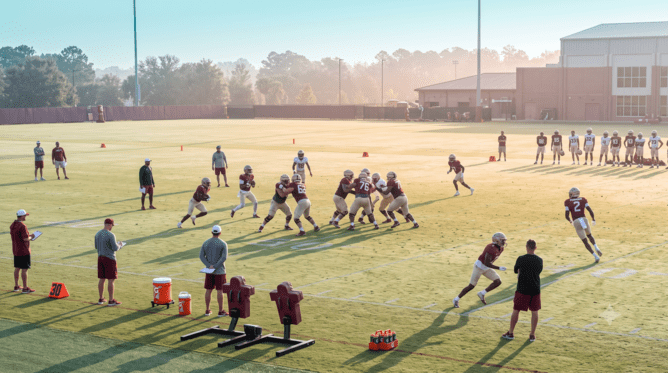
Robinson can raise Florida State’s ceiling, but he cannot be the entire ceiling. The Seminoles still need Daniels to process quickly, the line to hold up long enough for route concepts to develop, and secondary receivers to punish defensive attention. If those pieces lag, Robinson’s production could remain strong while the offense stays inconsistent.
The supporting cast will determine whether defenses can tilt everything toward No. 0. If another receiver becomes a consistent chain-mover, Robinson gets cleaner explosive opportunities. If the tight ends threaten the seams, safeties have harder choices. If the backs protect and release well, Daniels gets useful checkdowns when deep looks are covered.
That is where fall camp becomes decisive. Robinson’s status is settled. The rest of the passing game has to clarify around him. Florida State opens the 2026 season on August 29 at 7 p.m. against New Mexico State, according to the school’s preseason announcement, giving Norvell’s offense a fixed date to turn offseason structure into game rhythm.
The early schedule will test whether the buzz is functional. It is one thing for Robinson to make a preseason list. It is another for Florida State to use that respect as an offensive lever every week.
Why Robinson’s Buzz Could Change Florida State’s ACC Argument
Florida State’s 2026 ACC argument depends on whether the offense can create enough pressure to win games that turn into scoring races. Robinson gives the Seminoles the most credible offensive centerpiece on the roster. That does not guarantee an ACC title push, but it changes how opponents must prepare.
A strong Robinson season could give Daniels a trusted first answer, create more space for the run game, and make Florida State more dangerous when drives stall near midfield. A great Robinson season could make the Seminoles harder to defend than their broader roster questions suggest.
That is why the preseason buzz matters. It is not just a compliment. It is a sign that Florida State has a player the league already respects before the season begins. For a program trying to climb again under Norvell, that kind of weapon can speed up the offensive reset.
If Robinson turns his 2025 breakout into a more complete 2026 role, Florida State’s offense can become bigger, cleaner, and more explosive. The Seminoles still need answers around him, but the ceiling is higher because they already have the player every defense has to find first.