

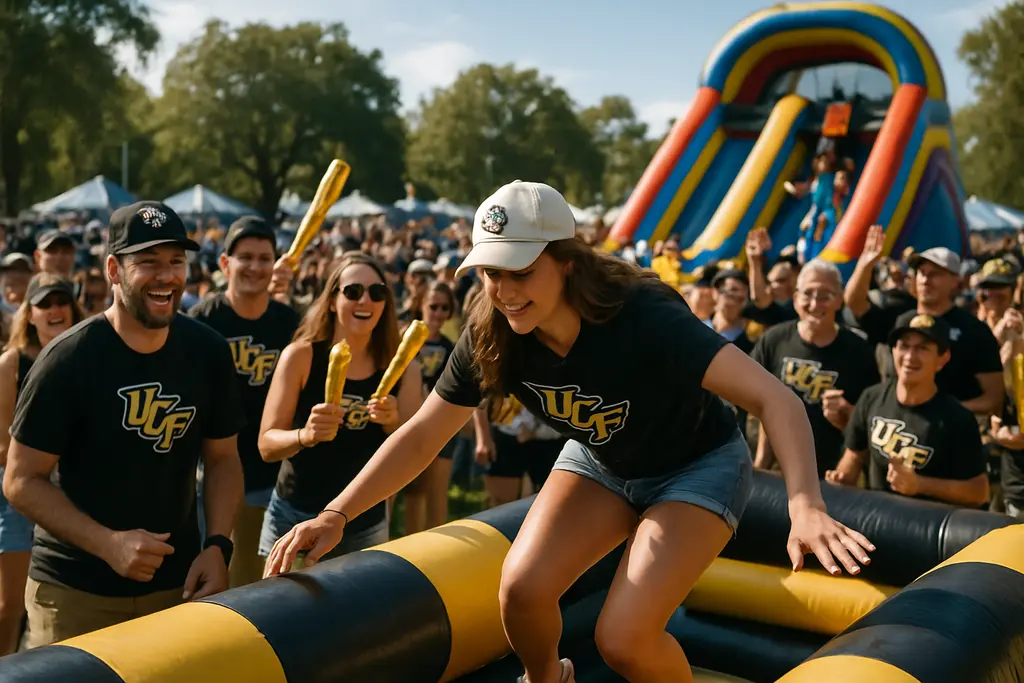
UCF Game-Day Innovations have become one of the sharper local sports stories around the Bounce House because the upgrades are not limited to bigger spaces or brighter lights. UCF students have been part of the show, building attractions that connect engineering, school identity and football atmosphere in a way that fits the Knights’ campus personality.
As of October 5, 2026, the most useful way to read UCF’s fan-zone changes is through two connected tracks. One is the student-built creative layer: launchers, character entrances, themed robotics and Knightro moments. The other is the venue operations layer: Roth Tower changes, concourse movement, concessions, parking and student access. Together, they show how a football Saturday can be shaped by both design work and practical planning.
Student Work At The Center Of UCF Game-Day Innovations
UCF Game-Day Innovations Built By Students
UCF engineering and computer science students have built several custom game-day attractions, including a double-barreled T-shirt launcher, a restored and customized Knightro golf cart, a 3D-printed robotic Citronaut spaceship playing AC/DC’s “Thunderstruck,” and a projection device designed to summon Knightro onto the field, according to UCF’s student feature. That list matters because it shows the fan zone as more than entertainment purchased off the shelf. It is being treated as a campus project, with students solving real stadium problems in front of a live crowd.
For a local fan, that changes the feel of the event. A T-shirt launcher is fun on its own, but a student-built version carries a different kind of ownership. The restored Knightro golf cart is not just a mascot vehicle; it is part of the pregame rhythm. The student connection gives alumni, families and current undergraduates a reason to look at the sideline and see campus work in motion.
Citronaut Theater And Knightro Entrances
The first “Citronaut’s Thunderstruck” debuted at the Mission IX Space Game on November 3, 2025. That date is already in the past, so the better question now is what it revealed about UCF’s approach. The 3D-printed robotic spaceship mixed the school’s space-game theme with sound, motion and character identity. In stadium terms, that kind of attraction helps fill the time between football sequences without making the building feel disconnected from the team.
The Knightro projection concept is another example. The device was tested in 2026 as a senior design project and, based on the UCF report, included specialized lights costing about $700, water cooling, emergency stop features and image projection through mirror slides. Its reported target was a later 2026 debut. As of October 5, 2026, the safest reading is that UCF had tested the project and was preparing it for a public game-day role, not that every fan had already seen it in regular use.
Roth Tower And Access Changes At The Bounce House
Club Space Changes Fans Can Feel
The largest 2026 stadium change sits in Roth Tower. UCF Athletics announced that the reimagined Roth Tower debuted for the 2026 football season with a 256% increase in usable club space, moving from about 4,400 square feet to about 15,650 square feet, along with 42% more club seats, 28 luxury suites that are 38% larger than before, and 34 new outdoor Sky Suites via the official UCF Athletics update. Those are premium-side changes, but they still affect the building as a whole because they change traffic patterns, sightlines, hospitality flow and the way different fan groups use the west side of the stadium.
For strategy-minded fans, this is not only a comfort story. Premium seating can shape donor engagement, recruiting impressions and the kind of game-day environment a program presents to prospects and families. It also changes how fans arrive, where they gather and how long they stay in the venue before and after key moments.
Movement Around The Stadium
UCF also introduced 360-degree concourse access for the 2026 season. That matters because stadium movement is one of the quiet drivers of fan satisfaction. If people can circulate more easily, they spend less time locked into one side of the venue and more time connected to the larger crowd. Enhanced stadium lighting, expanded premium spaces and fresh food and beverage options were also part of the 2026 update.
- Food items announced for 2026 included themed “Big 12 Dogs of the Game” hot dogs and a “Sword Pretzel” in premium areas.
- Student ticket claims were set to open at 10 a.m. each Monday of game week.
- Four concession locations were added outside the student section.
- A student rewards system and giveaways were included as part of the 2026 student experience plan.
The football piece is simple: a stadium that moves better can sound better. If students can claim tickets in a predictable window, find concessions near their section and earn rewards for attendance, the student section has fewer friction points before kickoff. That helps the Knights protect one of the Bounce House’s best assets: a crowd that can turn routine possessions into pressure snaps.
The Student Section As A Design Partner
Why Participation Drives Atmosphere
UCF Game-Day Innovations stand out because students are not being treated only as spectators. They are builders, testers and beneficiaries. That is a useful model for a school whose football identity has often leaned on speed, noise and shared campus energy. The best student-section ideas are not always the biggest ones. Sometimes they are the improvements that remove small barriers: clearer claim windows, nearby concessions, better rewards and more reasons to arrive early.
The attraction side and the operations side also feed each other. A Knightro entrance has more value if the crowd is already in place. A giveaway works better when access is easier. A themed food item becomes part of the conversation when fans can move around the venue without losing touch with the game. Those details sound small until a close fourth quarter makes every ounce of crowd energy matter.
Small Amenities With Game-Day Value
Several 2026 updates were practical rather than theatrical. UCF made parking adjustments that included new West Softball and F1 lots, added courtesy shuttles between Gate 14 and the softball complex and between Gate 14 and Garage H, and added a nursing room on Roth Tower’s first floor concourse. Those details may not create the loudest social clips, but they matter to families, older fans, students arriving from different parts of campus and supporters trying to make kickoff without stress.
The September 19, 2026 home game against Georgia State also included a free hat giveaway presented by Publix on a first-come, first-served basis. Since that date has passed, it should be read as part of UCF’s broader 2026 fan engagement pattern rather than as an upcoming promotion. Giveaways are not the core of football culture, but they can help turn a single game into a shared keepsake.
What Central Florida Fans Can Learn From The Model

A Campus Sports Culture Built Around Details
Across Florida, the strongest college football Saturdays tend to combine team performance, campus identity and local habits. Readers who track that statewide fan culture can compare UCF’s approach with how Gainesville football Saturdays are shaped by community routines. The UCF version has its own flavor: space-game themes, Knightro theatrics, student engineering and a stadium known for energy when the crowd is fully engaged.
That is why the student-designed pieces deserve attention from more than campus insiders. They show how a school can give future engineers and computer scientists work that ends up in front of a football audience. They also create a stronger connection between academic life and athletic life, which is valuable for a university trying to make Saturdays feel like a full-campus event.
Why Operations Still Decide The Day
Creative attractions get the spotlight, but operations decide whether fans leave satisfied. Parking, shuttles, concession placement, nursing space, concourse access and premium-area design all shape the same afternoon. A strong fan zone cannot overcome a frustrating entrance process or a confusing walk to the gate. UCF’s 2026 updates matter because they address both the show and the structure around the show.
For families, that means a less stressful day. For students, it means more reasons to attend and stay. For alumni, it means a stadium that feels familiar but not stale. For the football program, it means the crowd has a better chance to become an active part of the game rather than a group distracted by logistics.
Why UCF Game-Day Innovations Matter At The Bounce House
The strongest case for UCF Game-Day Innovations is that they match the personality of the place. A double-barreled T-shirt launcher, a restored Knightro cart, a robotic Citronaut, a projected Knightro signal and a rebuilt Roth Tower do not all serve the same purpose, but they all point in the same direction: a more engaged Bounce House.
From a strategist’s view, the value sits in the connection between emotion and execution. The emotional side gives fans something to remember before the score settles. The execution side helps them move, eat, gather, claim seats and bring families into the building with fewer obstacles. If UCF keeps pairing student creativity with stadium upgrades, the fan zone can become one of the program’s local advantages, not just a collection of between-play features.
That is the real story for Central Florida sports fans on October 5, 2026. UCF is not simply adding attractions around football. It is letting students help shape how football feels on campus, while the athletic department builds out the access, premium space and services needed to support that energy. The result is a Bounce House experience with a stronger campus signature and a clearer sense of place.