

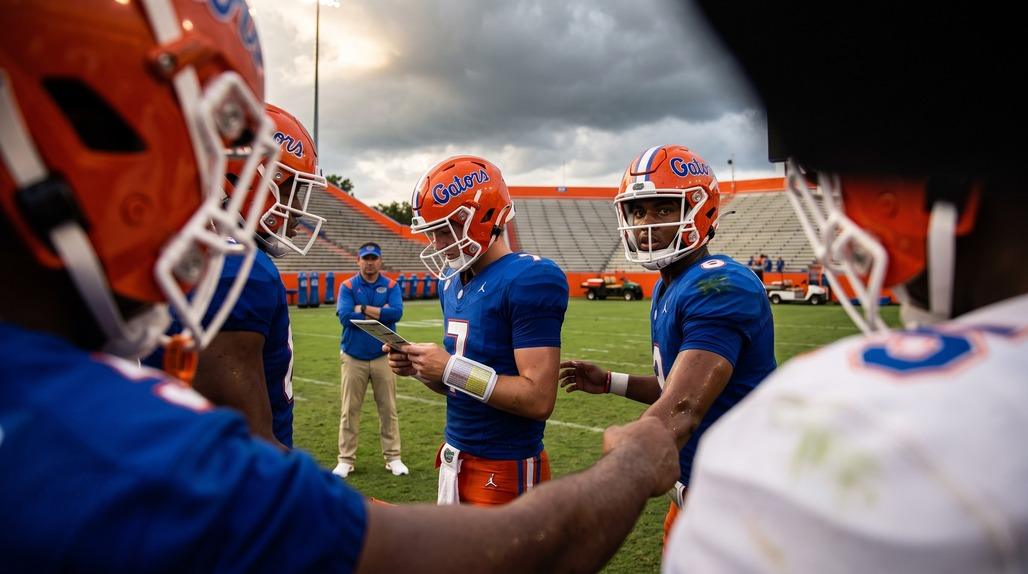
Florida’s first preseason scrimmage did not end the Gators’ quarterback competition. It made the stakes clearer. When Jon Sumrall reviewed the scrimmage on August 17, the first-year Florida head coach still described Aaron Philo and Tramell Jones Jr. as active contenders for the job, with the September 5 opener against Florida Atlantic at Ben Hill Griffin Stadium now close enough to turn every camp detail into evidence.
The official Florida update framed the moment plainly: when the Gators host Florida Atlantic at 7:45 p.m. on September 5, either Philo or Jones is positioned to become Florida’s 20th different starting quarterback since Tim Tebow. That is a stunning number for a program still trying to turn quarterback stability into SEC relevance. Sumrall’s first season in Gainesville may be judged by roster culture, offensive toughness, and long-term direction, but the first public test will almost certainly be the quarterback he chooses. Florida’s quarterback competition update
Why The First Scrimmage Changed The Evaluation
A scrimmage changes a quarterback battle because it pushes players closer to real football. Practice periods can isolate footwork, timing, and route execution. A scrimmage asks a quarterback to manage the full operation: shifts, motions, protection calls, pressure, mistakes, and the next play after something goes wrong.
That is why Sumrall’s focus after the first scrimmage matters. He said neither quarterback had moved far ahead of the other, and he pointed directly to line-of-scrimmage operation as the area both players must keep improving. That phrase is more important than any single throw from the scrimmage. It tells readers what Florida’s staff is really grading.
Philo reportedly threw both a touchdown pass and an interception in the scrimmage. The interception came from Cormani McClain, but Sumrall praised Philo’s response after the mistake. That may carry real weight because quarterbacks do not win jobs by avoiding every bad play. They win jobs by preventing a bad play from turning into a bad quarter.
Jones, by contrast, showed his arm on certain plays but did not produce the same signature scrimmage moment. Sumrall also said both quarterbacks had passes that could have been intercepted but were dropped. That keeps the competition open and gives the staff a more honest picture than a clean statistical summary would provide.
The result is a battle that remains alive because neither player has forced Florida’s hand. That can be good for competition. It can also become dangerous if clarity arrives too late.
Why Philo Still Has The System Advantage
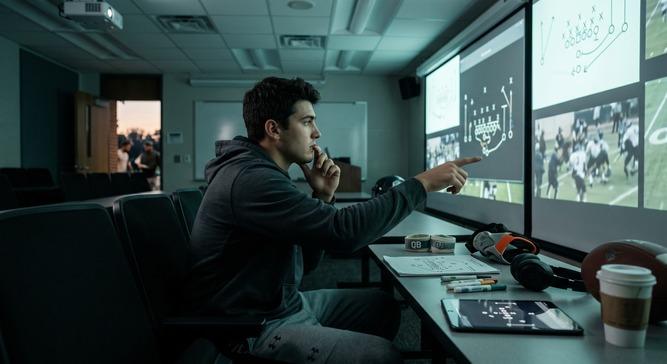
Philo’s case begins with familiarity. He transferred from Georgia Tech after working in Buster Faulkner’s offensive system, which gives him a head start in pre-snap structure, motion timing, terminology, and the rhythm of the call sheet. Florida’s official spring coverage noted that Philo had two seasons of Georgia Tech experience, throwing for 938 yards, two touchdowns, and three interceptions while completing 57.8 percent of his passes. Florida spring quarterback race
That background matters because Faulkner’s offense depends on quarterback processing before the snap. The quarterback has to handle motion, identify leverage, adjust protections, and know when the structure creates a favorable matchup. A player who has already lived inside that language has a practical edge, especially in a first-year coaching transition.
Philo also brings one specific kind of pressure relief for Sumrall. A new head coach does not want his first offense to look disorganized. If Philo can get Florida lined up cleanly, avoid wasted timeouts, and keep the ball out of trouble, he may give the staff the safest early-season floor.
That does not make him the automatic starter. The scrimmage interception matters because turnovers can erase a system advantage quickly. Florida’s schedule gives the Gators Florida Atlantic and Campbell before a September 19 trip to Auburn, but the SEC portion of the schedule will not forgive repeated mistakes. Philo’s best argument is control. His biggest risk is that control means little if Jones keeps closing the knowledge gap and adds more playmaking.
Why Jones Has Made This A Real Competition

Jones’ case is different. He gives Florida continuity inside the program, more time around the roster, and a higher developmental ceiling if the staff believes his growth rate will continue. Sumrall said Jones had been significantly behind Philo in understanding the offense after spring, but had shown more upward movement because he had more room to grow. That is a revealing detail.
The official roster profile shows why Florida invested in Jones. He was rated as a four-star recruit, an Elite 11 finalist, and the No. 4 quarterback nationally by Rivals in the class of 2025. His high school production included 7,197 passing yards, 75 touchdowns, 21 interceptions, and a 59.3 percent career completion rate. Tramell Jones Jr. roster profile
Those numbers are not enough to win an SEC job in 2026, but they explain why Florida is giving him every chance to claim it. Jones has arm talent, confidence, and a year in Gainesville. He also brings a natural connection to teammates who were part of the program before the coaching change.
His main challenge is operational. Sumrall pointed to motion, shifts, and line-of-scrimmage details as the next growth area. That is a common issue for a younger quarterback in a new system. The question is whether Jones can make the mental side automatic before the opener.
If he can, the competition changes. Philo’s system familiarity becomes less decisive. Jones’ playmaking, comfort in the pocket, and long-term upside become harder to ignore.
Why This Decision Defines Sumrall’s First Impression
Sumrall’s first Florida team needs a quarterback decision that supports his larger message. He arrived in Gainesville with a reputation for discipline, physicality, and directness. A shaky quarterback choice can undermine that quickly because the position becomes the public face of every offensive issue.
Florida’s recent quarterback history raises the pressure. The program has had flashes since Tebow, including Kyle Trask’s rise and Anthony Richardson’s talent, but long-term stability has been rare. The official Florida article placed this battle inside that larger post-Tebow context, which is exactly why the Philo-Jones decision feels larger than a normal camp competition.
Sumrall also has to think beyond September 5. He said in spring that the quarterback who starts Game 1 may not automatically start later games. That may be true competitively, but the staff still needs the opener to create confidence rather than confusion. If Florida starts one quarterback against FAU, rotates heavily against Campbell, and reaches Auburn still uncertain, the schedule can turn a manageable decision into a season-long debate.
That is where Sumrall’s evaluation has to be precise. The best quarterback is not always the one with the best arm or the cleanest practice day. It is the one who lets Florida play the most complete version of its offense.
The FAU Opener Gives Florida A Deadline, Not A Finish Line
Florida’s official schedule lists Florida Atlantic on September 5, Campbell on September 12, Auburn on September 19, Ole Miss on September 26, and Missouri on October 3. That opening month gives the Gators a layered quarterback test. FAU and Campbell can help the staff evaluate game management and rhythm. Auburn, Ole Miss, and Missouri will expose whether the chosen quarterback can survive SEC speed. Florida 2026 football schedule
The opener is a deadline because Florida must put someone on the field first. It is not a finish line because the staff may still need multiple games to know what the offense is. Sumrall has already acknowledged that the Gators may use early rotations across the offensive line as they figure out their identity. The quarterback position could follow a similar logic if neither player fully separates.
That approach carries risk. Rotation can help evaluation, but quarterbacks often need rhythm. Receivers need to know timing. The offensive line needs to understand cadence. Play callers need to feel what their quarterback handles best under pressure.
A two-quarterback opening stretch might make sense if the gap stays narrow. It could also delay the exact clarity Florida needs before conference play hardens.
| Quarterback Factor | Aaron Philo | Tramell Jones Jr. |
|---|---|---|
| Main Advantage | Prior experience with Buster Faulkner’s offensive system | Growth, arm talent, and program continuity |
| Key Question | Can he limit turnovers and turn system knowledge into steady production? | Can he master line-of-scrimmage operation fast enough to start? |
| Scrimmage Note | Threw a touchdown and an interception, then responded well | Showed arm talent but lacked a defining scrimmage moment |
| Long-Term Case | Gives the offense an experienced operator | Could give Florida a higher developmental ceiling |
| Biggest Risk | Mistakes could offset the system advantage | Mental operation may lag behind physical ability |
Why Line-Of-Scrimmage Control May Decide The Job

Sumrall’s repeated emphasis on line-of-scrimmage operation gives this battle its clearest key. That phrase covers more than checking to a run or pointing at a linebacker. It includes formation communication, motion timing, protection identification, tempo, and making sure the offense does not beat itself before the snap.
For Philo, line-of-scrimmage control should be the advantage that separates him. If he cannot create distance there, his case weakens. For Jones, progress in that area is the route to winning the job. If the younger quarterback can handle the same mental load, Florida can weigh his upside more heavily.
That is why the first scrimmage was so useful. It exposed the exact gap the staff needs to measure. The coaches now know which mistakes were physical, which were mental, and which came from pressure. Film from that scrimmage will likely mean more than public quotes because it shows whether a quarterback was late, wrong, or simply beaten by a good defensive play.
The winner of this job may not be the quarterback who creates the loudest play. It may be the one who makes the quietest corrections.
How The Supporting Cast Shapes The Choice
The quarterback decision also depends on the pieces around Philo and Jones. Florida’s offense is not starting from a finished product. The offensive line is still being evaluated, the staff is working through rotation questions, and the skill group has to settle into Faulkner’s system.
That affects the quarterback standard. If the line is still sorting itself out, mobility and pocket movement become more valuable. If the receivers need help getting aligned, the quarterback’s communication becomes more valuable. If the run game is strong, the staff may choose the player who protects possessions and hits play-action throws on schedule.
The best quarterback for Florida may be the one who fits the whole roster, not the one who wins a direct comparison on paper.
That is why Sumrall’s first season is so tied to this battle. Florida is not choosing between two finished SEC starters. It is choosing which developmental path gives the 2026 offense the clearest start.
Why The Gators Cannot Let The Battle Become The Season
A healthy quarterback competition can sharpen a team. A lingering quarterback debate can consume it. Florida is close to that dividing line because both players appear viable and neither has seized the job completely.
The Gators can live with a tight competition in mid-August. They cannot let every offensive mistake in September become a public referendum. Once the staff makes its decision, it has to support the starter with a plan that fits his strengths.
For Philo, that may mean quicker answers, pre-snap motion, and controlled throws that use his system knowledge. For Jones, it may mean building around his arm talent, comfort in the pocket, and a package that keeps his responsibilities clear early before expanding the menu.
The wrong outcome would be trying to make both quarterbacks play the same way. Their cases are different, and the offense should reflect that if one wins the job.
Why This Battle Could Define The Sumrall Era’s Opening Chapter
Florida’s Aaron Philo vs. Tramell Jones Jr. battle is more than a camp storyline because it sets the tone for Sumrall’s first visible football decision. A clean choice can make the Gators look organized. A messy process can make the new era feel unsettled before SEC play arrives.
Philo offers familiarity, experience, and the best immediate connection to Faulkner’s system. Jones offers growth, arm talent, and the possibility that Florida’s future at quarterback is already inside the building. The first scrimmage did not settle the question, but it sharpened the terms: line-of-scrimmage control, mistake response, and operational command will decide the job more than reputation.
That is the correct kind of tension for a new staff, as long as it produces clarity soon. Florida does not need its quarterback to carry the entire season in September. It needs him to make the offense look functional, protect the football, and give Sumrall a first month that feels like a foundation rather than a scramble.
If the Gators find that player before FAU, Sumrall’s first season can begin with a defined offensive identity. If the battle remains cloudy too deep into the schedule, the quarterback competition may become the story that defines the season before Florida ever reaches the heart of SEC play.