

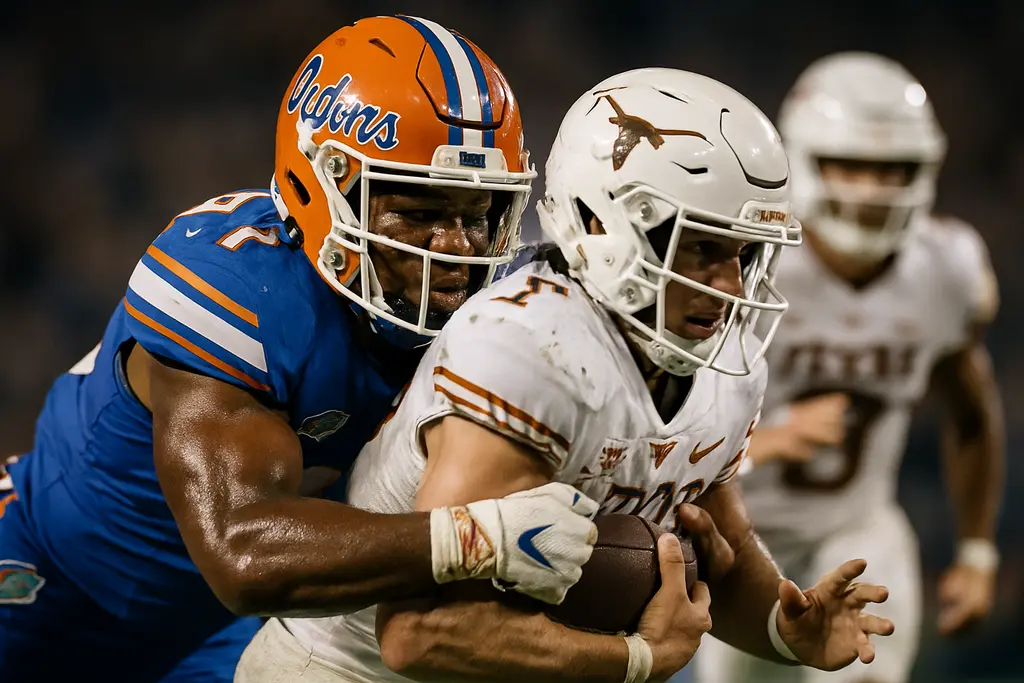
Florida Defense gave Gainesville a sharper football story on Oct. 17, 2026: a road upset that started poorly, tightened by possession, and ended with a pass rush snap that will stay in the local conversation for a while. Florida beat Texas 27-24 after entering the matchup with major defensive questions, then held the Longhorns to 272 total yards and closed the game on Myles Graham’s sack-strip with 1:58 remaining, as detailed in Florida’s official game recap.
For a Gators fan base that had seen defensive strain earlier in the schedule, the result mattered because it was not built on one lucky bounce. Florida absorbed Texas’ early surge, reduced the explosive damage, won key downs, and forced the Longhorns into a field-position game they could not finish. The win did not erase every concern from the season, but it gave Florida a working example of how this group can survive a rough start and still dictate the final quarter.
How Florida Defense Reset The Game In Texas
Florida Defense After The 17-3 Hole
The first part of the game did not look like a clean defensive turnaround. Texas built a 17-3 lead, and Florida had to answer both the scoreboard and the feeling that another long afternoon could form quickly. The key difference was what happened after that early damage. Florida did not let the game become a track meet, and Texas did not keep finding easy drive finishes.
The Florida Defense did not win by shutting down every snap. It won by forcing Texas to play more snaps under pressure and by turning late possessions into tense, low-margin situations. That type of response matters for a Gainesville audience because it speaks to game temperament. Road teams can lose structure fast after an early deficit. Florida instead used the middle of the game to bring the contest back into a form its offense and sideline could manage.
The Yardage Gap From Earlier Metrics
Before the game, Florida’s defense had been carrying numbers that invited skepticism. The unit entered ranked last in the SEC in total defense, allowing about 393 yards per game, and sat 131st nationally in pass defense at about 268.7 yards per game, according to Florida’s recap. Against Texas, the Gators allowed 272 total yards. That gap between prior form and game-day output is the center of the upset.
Texas finished with 99 rushing yards and 173 passing yards, while Florida’s defense totaled five sacks and 11 tackles for loss. The Longhorns went 2 of 10 on third down and 1 of 3 on fourth down, according to the official Florida-Texas box score. Those are not cosmetic numbers. They show a defense that repeatedly got Texas behind schedule, then finished enough possessions to keep the upset alive.
Pressure And Down-And-Distance Control
Myles Graham’s Closing Snap
The final defensive sequence gave the game its signature image. Arch Manning was sacked five times, and the last one carried the heaviest weight. Graham’s sack forced a fumble with 1:58 left, Florida recovered, and Texas lost its best late chance to flip the result. For fans back in Gainesville, that play turned a tense road finish into a clear example of defensive finishing.
Graham’s moment also showed why pressure production matters beyond the sack total. A pass rush does not need to dominate every dropback to change the shape of a fourth quarter. It needs to make the quarterback speed up, shorten reads, and protect the ball under stress. Florida did that often enough to make Texas’ passing game feel constrained even when the Longhorns found a chunk gain.
Third Down Told The Local Story
Third down was where Florida’s defensive plan became visible. Holding Texas to 2 of 10 on third down gave the Gators more than a statistical edge. It limited the Longhorns’ ability to stack plays, quieted the home-field rhythm, and created the possession balance Florida needed. That is the kind of hidden road-game factor fans sometimes feel before they can name it. When a defense gets off the field, the entire sideline breathes differently.
Fourth down mattered too. Texas converted only 1 of 3, and those failed chances added weight to Florida’s tackling and interior resistance. In a three-point game, one short-yardage stop can carry the value of a turnover. The Gators made Texas earn every extension, and that changed the tone of the second half.
Why Possession Helped The Gators Finish
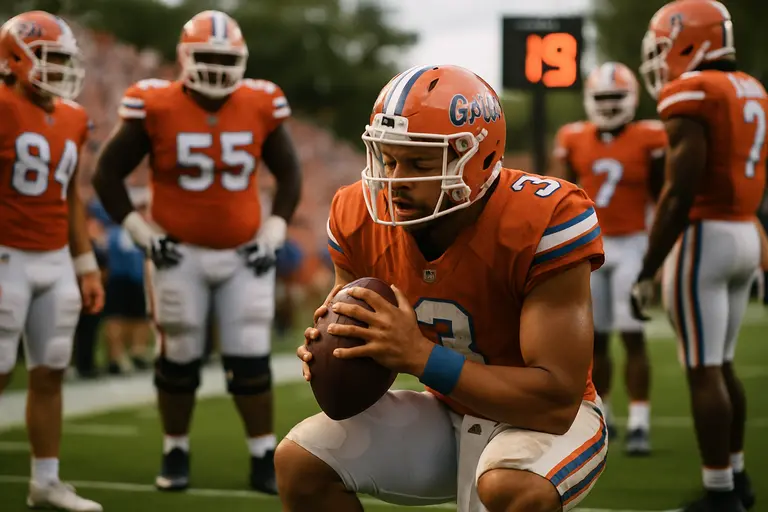
Florida’s 38:11 Clock Edge
Defense rarely works in isolation. Florida’s 38:11 time of possession, compared with Texas’ 21:49, gave the Gators a practical advantage that showed late. A defense that had been questioned for much of the season did not have to spend the entire second half chasing long series. The offense’s ability to hold the ball gave the defensive front more rest between high-stress possessions.
That matters in SEC-style road games because fatigue often appears first in tackling angles and pass-rush discipline. When a defense is worn down, short gains turn into first downs, quarterbacks escape contain, and fourth-quarter drives become longer than they should be. Florida avoided that pattern. The Gators still had enough energy for a late rush, and the final sack was the clearest sign.
The Gainesville Fan Read
From a local sports angle, the Texas win gave fans something more useful than a one-week celebration. It gave them a way to evaluate whether Florida’s defensive staff and players had found a repeatable formula: reduce rushing space, win third down, avoid extended defensive exposure, and let the pass rush arrive in the fourth quarter.
That formula also affects the game-day conversation around town. In Gainesville, defensive identity has always shaped how fans read a season. A win like this changes the week in coffee shops, campus walks, alumni text threads, and local radio because it gives people real plays to cite, not just optimism. The Gators did not need a perfect defensive box score. They needed proof that the group could answer a ranked-stage road challenge with composure.
What The Texas Win Says About Florida Defense
The Texas result should be framed carefully. One game does not fix every concern raised by earlier yardage totals, and Florida still allowed enough early scoring to create a deep hole. Still, the road upset showed that Florida Defense can be far more disruptive when the front wins early downs and the offense supports it with possession.
The most meaningful part was the order of events. Florida took the early punch, tightened the game, forced Texas into poor third-down production, and ended the final threat with a sack-fumble. That is a complete defensive arc, not just a late highlight. For a team trying to stabilize its season narrative, that kind of win travels well back to Gainesville.
The fan takeaway is direct: Florida’s defense earned a different level of attention after Oct. 17, 2026. Not because every weakness disappeared, but because the Gators showed how pressure, tackling, clock support, and late-game nerve can work together. In a 27-24 road upset at Texas, that was enough to change the tone of the week.